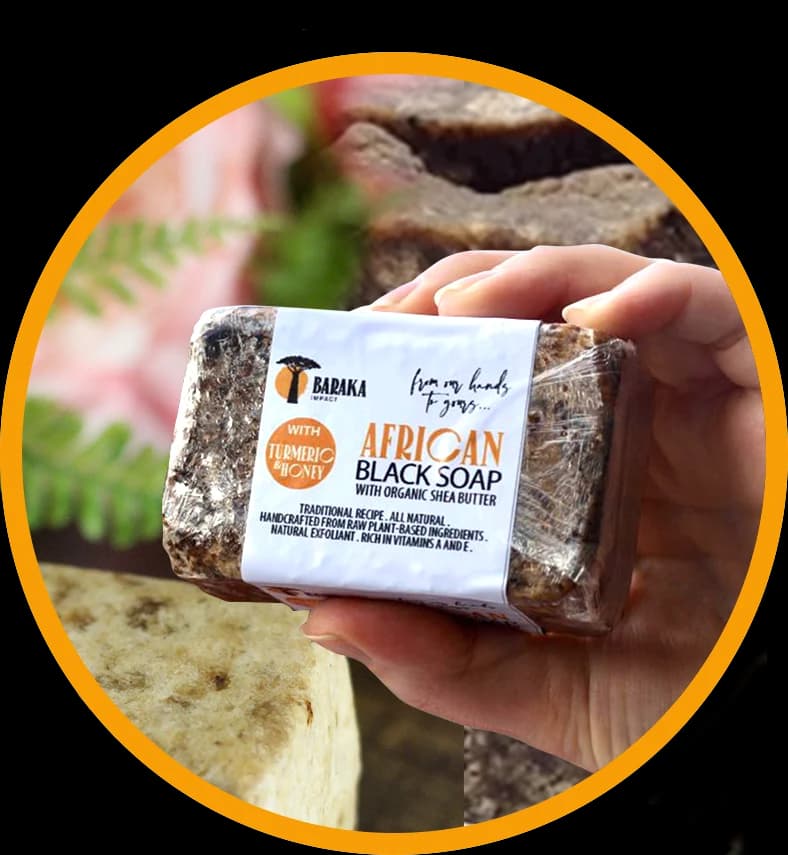
Turmeric & Honey African Black Soap, handmade in Ghana by women artisans
show on all variants
Turmeric & Honey African Black Soap, handmade in Ghana by women artisans
show on all variants

Turmeric & Honey African Black Soap — Handmade in Ghana

$6.11
$11.99
From $0.55/mo or 0% APR with
You are saving
49%
($5.88)
Sale
sizes:
1

Deep Cleanse. Traditional Recipe. Handmade in Ghana.

Turmeric & Honey African Black Soap is traditional African black soap, handmade by women artisans at the Konjeihi Women’s Enterprise Centre in Wa, Ghana. Every Baraka black soap bar is handmade using traditional ingredients and processes. There is no added fragrance, essential oil or colourant, and no parabens or sulfates.

Turmeric & Honey is named for two ingredients long used in skincare across West Africa and South Asia: turmeric root powder and raw honey.

Quick Specs:

  • Origin: Konjeihi Women’s Enterprise Centre, Wa, Ghana
  • Bar weight: 4.6 oz (130 g)
  • Packs: 1, 3, 5, 8, 12 or 24 bars
  • Key ingredients: Shea butter, palm kernel oil, traditional potash
  • Free from: Parabens, sulfates, added fragrance, essential oils, synthetic colours
Handmade by Women in Ghana
Trusted by 17,000+ Customers
Pure • Unrefined • Lab Tested

What Is Turmeric & Honey African Black Soap Used For?

It is an everyday cleanser for face and body. Black soap is traditionally used in Ghana to wash both skin and hair, and many people use Turmeric & Honey African Black Soap as a face wash, a body soap, a hand soap or a shaving soap. Like all true soap it is alkaline; if your skin feels tight after washing, use a little less and follow with a thin layer of Baraka shea butter.

How Do You Use Turmeric & Honey African Black Soap?

  1. Wet your hands and work the bar into a lather between them. Do not rub the bar straight onto your face.
  2. Massage the lather onto wet skin in gentle circles for 30 to 60 seconds.
  3. Rinse well with lukewarm water and pat dry.
  4. Keep the bar on a draining soap dish so it stays firm between uses.

If you are new to black soap, start every other day and build up to daily use. Patch test on a small area first.

Three Ways to Use It

1. Daily face wash. Wet your hands and rub the bar between them to make a lather. Massage the lather onto your wet face in gentle circles for 30 to 60 seconds, then rinse with lukewarm water and pat dry. Always lather in your hands first; do not rub the bar straight onto your face.

2. Body wash. Work up a lather between your hands or on a damp washcloth, apply to wet skin and rinse well.

3. Shaving soap. Work up a rich lather and apply it to the area you are shaving, then rinse and follow with your usual moisturizer.

Pro Tips

  • It does not stain: as a rinse-off soap, the lather is on your skin too briefly for the turmeric colour to transfer, and it rinses cleanly.
  • Start gradually: if you are new to black soap, use it every other day at first and build up to daily use.
  • Always lather first: make the lather in your hands before it touches your face.
  • Patch test first on a small area before using it on your face.

Handmade black soap is soft and may crumble slightly; that is normal, because nothing is added to harden it. If your skin feels a little dry in the first few days, use it less often or follow with a light moisturizer.

Our Story: Traditional Craft from Ghana to You

African black soap, known in West Africa as “ose dudu” or “alata samina”, has been part of West African skincare for centuries. The women dry cocoa pods and plantain peels in the sun, roast them into a dark ash, and cook that ash with shea butter and palm kernel oil, with turmeric, raw honey and plant powders worked in, stirring by hand. This bar is named for its turmeric and honey.

Every bar is made by women at the Konjeihi Women’s Enterprise Centre, who learned the craft through generations. See what your purchase makes possible in YOUR IMPACT: Anbannah Celina, read the full story in our Impact Report, and learn more in Fair Trade Shea Butter: The Konjeihi Women’s Enterprise Centre Story.

How Can You Tell Real African Black Soap?

Real African black soap is made by hand from plant ash and oils, not from a commercial soap base with colour added. Baraka’s bars are cooked by hand by the women of the Konjeihi Women’s Enterprise Centre in Ghana, with traditional potash made from the ash of cocoa pods and plantain peels. That is why every bar looks a little different: the colour runs from dark brown to near-black, and the texture is soft, slightly uneven and naturally a little crumbly.

Our products are tested periodically by the Ghana Standards Authority (GSA), Ghana’s national standards body and a member of the International Organization for Standardization (ISO). Testing is carried out in GSA laboratories accredited to ISO/IEC 17025, using internationally recognised ISO and CEN test methods, against the Ghana Standard for each product. Product specifications and our latest Ghana Standards Authority test summary are available on request.

Learn more in How Traditional African Black Soap Is Made and Real vs Fake African Black Soap.

What’s In Turmeric & Honey African Black Soap?

What goes in: Shea butter; Palm kernel oil; Traditional potash, made from the ash of cocoa pods and plantain peels; Water; Red palm oil; Raw honey; Turmeric root powder; Cocoa powder; Moringa leaf powder; Neem leaf powder; Hibiscus flower powder; Baobab fruit pulp; Lemongrass leaf powder; Aloe vera leaf powder.

Ingredients in the finished soap: Saponified shea butter (Potassium Shea Butterate); Saponified palm kernel oil (Potassium Palm Kernelate); Glycerin (Glycerin); Water (Aqua); Red palm oil (Elaeis Guineensis Oil); Raw honey (Mel); Turmeric root powder (Curcuma Longa Root Powder); Cocoa powder (Theobroma Cacao Seed Powder); Moringa leaf powder (Moringa Oleifera Leaf Powder); Neem leaf powder (Melia Azadirachta Leaf Powder); Hibiscus flower powder (Hibiscus Sabdariffa Flower Powder); Baobab fruit pulp (Adansonia Digitata Pulp Extract); Lemongrass leaf powder (Cymbopogon Citratus Leaf Powder); Aloe vera leaf powder (Aloe Barbadensis Leaf Powder).

Why the two lists are different: African black soap is made the traditional way, by cooking shea butter and palm kernel oil with potash from plant ash. As it cooks, the potash turns the oils into soap and is used up in the process, so it does not remain in the finished bar. That is why the finished soap lists "saponified" shea butter and palm kernel oil, meaning the oils after they have become soap, and why glycerin appears: it forms naturally as the oils turn into soap. The second list uses the international ingredient names (INCI) that appear on our label and in our Health Canada notification.

Common names: turmeric honey black soap, African black soap with turmeric, turmeric black soap.

What Each Ingredient Does

Turmeric root powder has long been used in skincare in West Africa and South Asia, and gives the bar its golden flecks. Raw honey is a natural humectant, which means it attracts moisture. Shea butter leaves skin feeling soft rather than tight after washing. Palm kernel oil gives the soap its creamy lather. Neem leaf powder is traditionally used in West Africa for washing. Traditional potash, the dark ash of roasted cocoa pods and plantain peels, is what turns the oils into soap and gives black soap its colour.

What You’ll Experience

  • Appearance: dark brown to black, with natural golden flecks of turmeric; every batch varies a little
  • Texture: a soft, pliable bar, softer than commercial soap
  • Lather: creamy, with a faint golden tint that rinses cleanly
  • Scent: mild and earthy, with warm honey and turmeric notes and no added fragrance

What Is Not In It

No parabens, sulfates, added fragrance, synthetic colours or synthetic brightening agents.

Signs of Authenticity

Real handmade black soap with turmeric is soft and pliable, may show golden-brown flecks of real turmeric powder, and does not have the uniform look of factory-made soap. A faint golden tint in the lather is real turmeric, not added colour.

Got Questions? We've Got Answers.

Q: How often should I use it?
A: Most people use Baraka's Turmeric & Honey black soap daily for face and body. If you are new to black soap, start every other day and build up to daily use as your skin adjusts.

Q: Why is my Turmeric & Honey African Black Soap soft and crumbly?
A: Baraka's handmade traditional black soap is naturally soft and pliable; nothing is added to harden it, so this is a sign it is made the traditional way, not a defect. Keep it dry between uses on a draining dish, and cut a large bar into smaller pieces if you like.

Q: Will it stain my skin yellow?
A: No. Used as a wash-off soap, Baraka's Turmeric & Honey bar does not stain skin: the lather is on the skin too briefly for the colour to transfer, and it rinses cleanly. You may see a faint golden tint in the lather; that is the turmeric and is normal.

Q: Is it vegan?
A: No. Baraka's Turmeric & Honey bar contains raw honey, so it is not vegan.

Q: How is Baraka black soap made?
A: Every Baraka black soap bar is handmade using traditional ingredients and processes, by women at the Konjeihi Women’s Enterprise Centre in Ghana. The full ingredient list for this bar is in the ingredients section on this page.

Q: How do I tell this black soap is real?
A: Real African black soap, like Baraka's, is cooked by hand from plant ash and oils, so each bar varies a little in colour and texture and is naturally soft. A perfectly smooth, uniform, jet-black bar is usually factory-made. See Real vs Fake African Black Soap.

Q: Can African black soap go bad?
A: Kept dry, Baraka's black soap keeps for 2+ years. Store it in a cool, dry place and keep the bar you are using on a draining soap dish.

Q: How long does a bar last?
A: Used once a day on your face, one Baraka bar lasts about four to six weeks; used on face and body, about two to three weeks.

Buying Turmeric & Honey African Black Soap: Your Questions Answered

Where can I buy turmeric soap?

Right here at barakasheabutter.com. Turmeric & Honey African Black Soap is traditional African black soap made with turmeric root powder and raw honey, cooked by hand by women at the Konjeihi Women’s Enterprise Centre in Ghana. We ship across the US and Canada.

Is there an African black soap with turmeric?

Yes. Baraka's Turmeric & Honey African Black Soap contains turmeric root powder and raw honey.

Which is better, turmeric soap or African black soap?

Baraka's Turmeric & Honey bar is both: traditional African black soap that contains turmeric root powder and raw honey. Many soaps sold as turmeric soap are ordinary soap with turmeric added; this one is cooked the traditional way from shea butter, palm kernel oil and plant-ash potash.

Is turmeric and honey soap made in Ghana?

Yes. Baraka's Turmeric & Honey bar is made by hand by women at the Konjeihi Women’s Enterprise Centre in Wa, Ghana.

What is in Baraka’s turmeric and honey black soap?

Baraka's Turmeric & Honey bar is shea butter and palm kernel oil cooked with traditional potash made from the ash of cocoa pods and plantain peels, with water, red palm oil, raw honey and plant powders: turmeric root, cocoa, moringa leaf, neem leaf, hibiscus flower, baobab fruit pulp, lemongrass leaf and aloe vera leaf. The full lists are in the ingredients section above.

What is the difference between turmeric soap and African black soap?

African black soap is the traditional West African soap that gets its dark colour from the ash of roasted cocoa pods and plantain peels, cooked with shea butter and oils. Many turmeric soaps are ordinary soap with turmeric added. Baraka’s Turmeric & Honey bar is traditional African black soap that contains turmeric root powder and raw honey.

How big is the bar, and how long does it last?

Each Baraka Turmeric & Honey bar weighs 4.6 oz (130 g). Used once a day on your face it lasts about four to six weeks; on face and body, about two to three weeks. You can order 1, 3, 5, 8, 12 or 24 bars.

Which pack size should I choose?

Start with 1 or 3 bars if you are new to black soap. Larger packs of 5, 8, 12 or 24 bars suit families, gifts and anyone who wants a steady supply. Baraka’s other bars: Classic, Hard, Aloe Calm, Mango, Banana and Fruit Blend.

Every order supports the women of the Konjeihi Women’s Enterprise Centre. See how in our Impact Report.

Why Choose Baraka

Handcrafted by women in Ghana using age-old techniques passed down through generations. Centuries of practice has taught them how to extract every bit of goodness from the shea nut, and that quality is now passed on in every package of shea butter and all the products made from it.

Shipping & Returns

We ship worldwide from our fulfillment centre in North America. At checkout you can see shipping options and costs. If you would like to arrange your own shipping please select warehouse pickup and send us an email to confirm. We can provide you with shipping and pickup details for your courier of choice. We hope you love your Baraka products. If you are unsatisfied for any reason though, we offer no hassle returns with no time limit, just contact us.

HOW BLACK SOAP IS MADE

Black Soap is an incredible product that is just starting to be known and used in North America.

Ghanaian women have been making black soap with shea butter for generations. Taught by their mothers and grandmothers as they were growing up, Ghanaian women make and use black soap.

Follow along in this video as we interview Amina Yussif where she explains how it is made and how it is part of the traditional shea butter process.

HANDCRAFTED BLACK SOAP

FROM OUR HANDS TO YOURS

Baraka Black Soap is handmade from pure, natural, and traditionally sourced ingredients by hard-working Ghanaian women. Baraka Black Soap uses traditional potash made from the ash of cocoa pods and plantain peels.

ALL NATURAL

No chemicals, additives, animal testing, or harsh industrial processing. Just pure, natural black soap.

COMMUNITY IMPACT

Every time you purchase Baraka’s black soap you have a direct impact on the women, families, and communities in northern Ghana. Not only does your order provide the dignity of income to hardworking women but helps support educational and economic projects in the community.
Image

BENEFITS

Gentle yet effective, black soap has a wide range of benefits:

  • Natural exfoliant for smoother skin
  • Rich in vitamins A & E
  • Contains shea butter and palm kernel oil to moisturize the skin

TURMERIC & HONEY BLACK SOAP

Honey, a natural humectant, helps the skin to retain moisture. Turmeric is traditionally used in West African and South Asian skincare for a brighter-looking, glowing complexion. This soap contains neem leaf powder.

Learn about the amazing benefits of using Black Soap  here .

Turmeric & Honey African Black Soap — Handmade in Ghana Reviews

Our Customers

Also Love

$5.40
$18
Save 70% ($12.60)
$5.40
$18
Save 70% ($12.60)
$5.70
$18.99
Save 70% ($13.29)
$5.40
$18
Save 70% ($12.60)
$5.40
$18
Save 70% ($12.60)
$6.11
$11.99
Save 49% ($5.88)