Red Palm Oil: A Red Well Full of Skin & Hair-Care Benefits
Many people find red palm oil a good ingredient for DIY skin care. Baraka Red Palm Oil is rich, absorbs easily, blends well and adds a deep orange-red colour. It is traditionally used on skin and hair, but it tints skin and stains cloth. This is DIY advice, not medical advice. See a doctor or pharmacist for any skin condition.
Palm oil does not hold the best reputation these days, but thankfully, with Baraka, I know it is sourced from small-holder farmers and hand-grown and harvested. Read why Baraka Palm Oil is sustainable here.
Red palm oil keeps its natural colour, which comes from the carotenoids in the fruit. Those carotenoids include beta-carotene, which the body turns into vitamin A. The oil also naturally contains vitamin E.

Quick answers
Is red palm oil good for skin?
Many people find it is. Baraka Red Palm Oil is a rich, easily absorbed oil, and red palm oil is traditionally used in body butters, balms and face masks. It is not a medicine and not a treatment for any skin condition. It keeps its natural colour, so it tints skin and can stain cloth and surfaces. More in Is red palm oil good for skin?
Can you put red palm oil on your face?
Yes, Baraka's guide explains that red palm oil is used in homemade face masks. It blends well with shea butter and cocoa butter and absorbs easily. It has a strong colour and a savoury, earthy smell, and it can tint skin and stain towels and clothes. More in Can you put red palm oil on your face?
Is red palm oil good for hair?
As Baraka's guide notes, many people use red palm oil as a hair mask. Apply it to the hair, massage it into the hair and scalp, leave it for 15 to 20 minutes, then rinse and wash as normal. It can be used alone or mixed with avocado oil, about once a week. Its strong colour can stain towels and pillowcases. More in Is red palm oil good for hair?
Is red palm oil good for skin?
Many people find it is. Red palm oil is a rich oil that sits well in body butters, balms and face masks, and many people say it leaves their skin feeling soft and smooth. That is reported experience and traditional use, not a promise. It is not a medicine, and it is not a treatment for acne, eczema or any other skin condition.

What red palm oil is
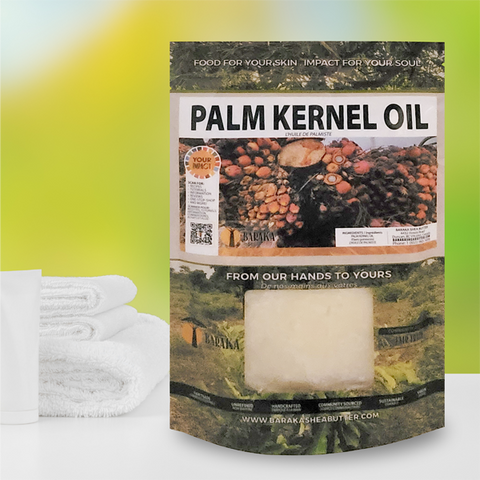
Red palm oil is pressed from the fruit of the oil palm, the orange flesh around the stone, not the kernel inside it. It is not the same as palm kernel oil, which comes from the kernel and is white to pale yellow. The two oils look different, feel different and behave differently in recipes.
What is in it
Red palm oil naturally contains carotenoids, including beta-carotene, and vitamin E. It is also a mix of fatty acids, which is why it feels rich on the skin. Those are plain facts about the ingredient. They do not add up to a guaranteed result on your skin, and everyone's skin is different.
My skin felt smoother
I dealt with acne, on and off, from my teenage years. The usual supermarket facial creams against acne never really did it for me. Sometimes they seemed to help, but over time they became less and less effective. I started using a face mask with red palm oil and I liked how smooth my skin felt afterwards. That is my own experience. Red palm oil is not a treatment for acne, so if you have acne that bothers you, ask a dermatologist.
I tried it on my hair
After my skin trial I wondered what other uses red palm oil had. Like you, I googled a bit and then tried it as a hair mask. I like how my hair looks and feels after using it.
The one big warning: staining
Red palm oil stains. Its strong colour transfers to skin, towels, pillowcases and clothes, and it may not come out of fabric. Use a little at a time, keep an old towel for it and wear clothes you do not mind marking. Kombo butter stains in the same way.
Red palm oil benefits for skin
Here is what people report and what the oil is traditionally used for. None of this is a medical claim.
- Rich feel. It is a thick, rich oil, so a little goes a long way.
- Easy to blend. It mixes well with shea butter, cocoa butter and kombo butter in balms and body butters.
- Natural colour. It adds a warm orange tint to the finished product, which many DIY makers enjoy.
- Natural vitamins. It contains vitamin E and carotenoids, which give the colour.
- Traditional use. Red palm oil has long been used on skin and hair in the parts of West Africa where the oil palm grows.
Its search names vary: people look for red palm oil benefits, palm oil benefits for skin and red oil for the face. They all mean the same oil, so the same advice applies. Check that the oil you buy is red palm oil and not palm kernel oil or refined palm oil.
Can you put red palm oil on your face?
Yes, Baraka's guide explains that red palm oil is used in homemade face masks. It blends well with shea butter and cocoa butter and absorbs easily. It has a strong colour and a savoury, earthy smell, and it can tint skin and stain towels and clothes. Use a thin layer and keep it away from your eyes.
Simple red palm oil face mask
This is a rinse-off mask, so it needs no storage line. It has no water in it.
- 1 tbsp (0.5 oz, 14 g) Baraka Shea Butter
- 1 tsp (0.2 oz, 5 g) Baraka Red Palm Oil
- Warm the shea butter in a small bowl set over warm water until soft, not fully melted.
- Stir in the red palm oil until smooth.
- Smooth a thin layer over clean skin and leave it for 10 minutes.
- Wipe off with a warm, damp dark cloth, then rinse and wash your face as normal.
Buy the ingredients now
This recipe uses two Baraka ingredients. One click takes both straight to checkout.
- Baraka Raw Shea Butter, 1.8 oz (50 g): enough for three batches
- Baraka Red Palm Oil, 1.8 oz (50 g): enough for several batches
Make only what you will use. Do not add essential oils to a face mask unless you keep them to 1% or less.
Red palm oil on the face every day for pimples: what to know
Red palm oil is not a treatment for pimples or acne, so it is not a good idea to count on it. It is a rich oil, and some people with skin that breaks out find rich oils feel too heavy to use daily. If you want to try it, start with a thin layer once or twice a week and see how your skin responds. If breakouts continue or get worse, stop using it and ask a dermatologist.
Red palm oil for mature skin: what to know
Many people with mature skin like rich oils and butters because they feel comforting and cushiony. Red palm oil is a rich oil, and mixing it with shea butter gives a thicker, more balm-like feel. We make no anti-aging promises. Try a small amount in a body butter or mask, and see how your skin feels.
Is red palm oil good for hair?
As Baraka's guide notes, many people use red palm oil as a hair mask. Apply it to the hair, massage it into the hair and scalp, leave it for 15 to 20 minutes, then rinse and wash as normal. It can be used alone or mixed with avocado oil, about once a week. Its strong colour can stain towels and pillowcases.
Red palm oil hair mask
Sometimes I use red palm oil by itself, sometimes I mix it with avocado oil. It is simple.
- Use about 1 tbsp (0.5 oz, 14 g) of red palm oil for short hair, or up to 2 tbsp (1 oz, 28 g) for long hair. Mix in 1 tbsp (15 ml) of avocado oil if you like.
- Apply it to your hair like any hair mask.
- Massage the hair and scalp.
- Leave it for about 15 to 20 minutes, with an old towel around your shoulders.
- Rinse, then wash your hair normally. A gentle shampoo is best if you can.
Do this about once a week. People often ask about palm oil benefits for hair. Many people say their hair looks and feels softer, which is reported experience and not a claim.
What each ingredient does
- Red palm oil: adds richness and colour. It is soft at room temperature and absorbs easily.
- Shea butter: rich and creamy. It gives body and a firmer feel, and it is traditionally used on skin in Ghana.
- Cocoa butter: firm and brittle, so it makes a mix harder and holds its shape.
- Kombo butter: traditionally used as a massage butter in Ghana. Blend it at 20 to 30% with shea butter and test it on the inside of your arm for 24 hours first. It stains, and is never for babies.
- Avocado oil: light and soft. It makes a hair mask runnier and easier to spread.
How to change the texture
The rule of thumb: butters make it rich, oils make it soft and light, wax makes it hold its shape.
- Firmer or thicker: add more shea butter or cocoa butter, or a little beeswax.
- Softer or runnier: add more red palm oil or a light oil such as avocado oil.
- Lighter: use more oil and less butter, and apply a thinner layer.
- Richer: use more shea butter.
Change one thing at a time and write it down.
Hawaiian Red Sea Salt & Red Palm soap recipe
This is a soap recipe from Soap Deli News that I found on a Google search and wanted to share. The lye and water amounts below are recalculated from saponification values.
|
|

Ingredients
- 12.6 oz (357 g) Baraka Red Palm Oil
- 7.2 oz (204 g) Baraka Coconut Oil
- 3.6 oz (102 g) GMO free sunflower oil
- 3.6 oz (102 g) GMO free safflower oil
- 1.8 oz (51 g) castor oil
- 7.2 oz (204 g) pomace olive oil
- 10 oz (284 g) distilled water
- 5.02 oz (142 g) sodium hydroxide (lye), calculated below
- 2 tbsp (30 ml) Hawaiian red salt
- Optional: up to 2 tbsp (30 ml) essential oil in total
- Optional: 2 tbsp (30 ml) kaolin (white cosmetic) clay
- Optional: 2 tbsp (30 ml) titanium dioxide powder
- Optional: activated charcoal powder (for the pencil line)
How the lye is calculated
No butter or oil contains lye. Each oil has a saponification value, which is how much sodium hydroxide a soapmaker must add per ounce of that oil to turn it into soap. Multiply each oil's weight by its value, add them up, then take 5% off for superfat.
- Red palm oil: 12.6 oz x 0.142 = 1.789 oz
- Coconut oil: 7.2 oz x 0.183 = 1.318 oz
- Sunflower oil: 3.6 oz x 0.134 = 0.482 oz
- Safflower oil: 3.6 oz x 0.136 = 0.490 oz
- Castor oil: 1.8 oz x 0.128 = 0.230 oz
- Olive oil: 7.2 oz x 0.135 = 0.972 oz
- Total for 36 oz (1,021 g) of oils: 5.281 oz
- At 5% superfat: 5.281 x 0.95 = 5.02 oz (142 g) of lye
- Water, about twice the lye: 10 oz (284 g)
Always check the recipe in a lye calculator before you make it.
Instructions
- Follow your cold process soapmaking instructions. If you have never made cold process soap, you can find a beginner's recipe here. Wear goggles and gloves when you work with lye.
- Weigh the distilled water into a heat-safe pitcher. Weigh the lye on a digital scale. In a well-ventilated area, slowly pour the lye into the water and stir until it dissolves. Set it aside to cool.
- Weigh the oils and combine them in a stainless steel pot. Heat on medium until melted, then remove from the heat and let cool.
- When both the lye-water and oils are at 90 to 95°F (32 to 35°C), pour the lye-water into the oils and mix with a stick blender to a light trace. Add the essential oil, if using, and mix again to a medium-heavy trace. Use no more than 1 tbsp of essential oil per 16 oz (454 g) of oils.
- Pour half of the soap into your prepared mould. For a pencil line, spread a thin layer of activated charcoal on top.
- Stir the Hawaiian red sea salt, kaolin clay and titanium dioxide into the remaining soap, then pour it on top.
- Level the top with a butter knife. Top with more Hawaiian red sea salt if you like, then cover the mould lightly.
- Let the soap rest for 24 to 48 hours before un-moulding. Cut into bars and let them cure for 4 to 6 weeks before use.
Buy the ingredients now
This recipe uses two Baraka ingredients. One click takes both straight to checkout.
- Baraka Red Palm Oil, 2.2 lb (1 kg): enough for two batches
- Baraka Virgin Coconut Oil, 17.6 oz (500 g): enough for two batches
Sunflower oil, safflower oil, castor oil, pomace olive oil, distilled water, sodium hydroxide (lye), Hawaiian red salt, essential oil (optional), kaolin clay (optional), titanium dioxide powder (optional) and activated charcoal powder (optional) are not Baraka products; use your usual supplier.
This is a colourful bar made with red palm oil and Hawaiian red sea salt. It takes patience, but it is worth the wait.
Make it your own
These recipes are a starting point, not a rulebook. Use your judgement, be inspired, and don't be afraid to experiment. Everything here is a pure, natural ingredient that blends happily with the others. Start with a small batch, write down what you did, and see how your skin and hair respond. When you find a blend that works for you, make it again.
To learn more
To learn more about our products, use the links below:
- Buy Baraka Palm Oils and Recipe Kits
- Read our blogs about palm oils
- Find DIY recipes using Baraka Palm Oil
- Watch a video interview about Baraka Palm Oil
- Read the Baraka Impact Report
About the author
Marta is a runner, a yogi and a DIY lover. During Corona she became a DIY fanatic, trying out a number of natural products and different ways to apply them. She also lives in London, surfs in Spain and adventures globally.
Items Featured in this Post


Connect With Us!


